Certified and Vulnerable: Why Third-Party Compliance Badges Are No Substitute for Real Enterprise Security
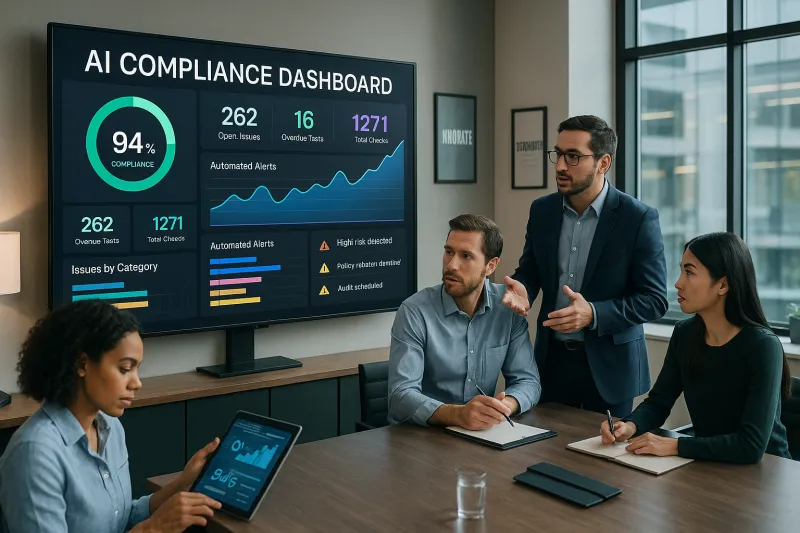
Photo: enterprise security compliance audit documents office professional, via api.ziasign.com
For procurement teams and risk officers at large US enterprises, the question used to be relatively straightforward: does this vendor hold a SOC 2 Type II report? Does their platform carry an ISO 27001 certification? If the answer was yes, the conversation often ended there. A signed attestation, a dated certificate, and a checkbox in the vendor management system — and the organization moved on.
That framework made a certain kind of sense when third-party ecosystems were smaller and certifications were harder to obtain. Today, it has quietly become one of the most consequential blind spots in enterprise risk management.
The Certification Economy
The market for compliance certifications has expanded dramatically over the past decade. Hundreds of auditing firms now offer SOC 2 readiness services, ISO 27001 gap assessments, and accelerated certification pathways. Platforms have emerged specifically to help software vendors achieve audit-ready status in weeks rather than months. The result is a market flooded with certified vendors — many of whom earned their badge through a snapshot audit that captured a single point in time, under conditions that may bear little resemblance to their day-to-day operational reality.
This is not an indictment of the certification frameworks themselves. SOC 2, developed by the American Institute of CPAs, and ISO 27001, an internationally recognized standard, both reflect genuine security principles when applied rigorously. The problem is not the standard — it is what the standard has become in practice: a commercial product sold to vendors who need to check a box for their enterprise customers, rather than a meaningful signal of sustained security maturity.
Enterprises, for their part, have been willing participants in this dynamic. Vendor review cycles are time-consuming, security resources are stretched thin, and procurement pipelines move fast. Outsourcing the judgment call to an auditing firm feels efficient. It distributes accountability. It produces documentation that holds up in board presentations and regulatory filings.
It does not, however, reliably prevent breaches.
What the Audit Doesn't See
A SOC 2 Type II report covers a defined period — typically six to twelve months — and evaluates controls across five trust service criteria: security, availability, processing integrity, confidentiality, and privacy. What it cannot capture is what happens between audits. Vendors rotate staff, change infrastructure providers, deprecate security tooling, or scale operations in ways that introduce new vulnerabilities long after the auditors have left.
ISO 27001 certifications carry a three-year validity window with annual surveillance audits, but those surveillance reviews are generally narrower in scope than the initial certification assessment. A vendor that passed a rigorous initial audit in 2022 may have undergone significant architectural changes that were never subjected to equivalent scrutiny.
More fundamentally, neither framework is designed to evaluate the specific risk that a given vendor poses to a specific enterprise customer. A cloud storage provider certified under both frameworks may still store enterprise data in a configuration that violates the customer's own internal data classification policies. A certified SaaS platform may integrate with dozens of subprocessors — each with their own security posture — that appear nowhere in the primary vendor's audit report.
Enterprise security teams that have begun scrutinizing subprocessor chains are often surprised by what they find: fourth- and fifth-party dependencies that carry their own vulnerabilities, and whose security controls were never evaluated as part of the original vendor selection process.
The Shared Responsibility Misunderstanding
Part of what sustains this dynamic is a persistent misunderstanding of shared responsibility in cloud and SaaS environments. When a vendor holds a SOC 2 report, enterprise customers frequently interpret that as a warranty of end-to-end security — when in practice, the vendor's responsibility typically extends only to the security of the platform itself, not to how the customer configures it, what data they store within it, or how they manage access.
Misconfiguration remains one of the leading causes of enterprise data exposure in the United States, and misconfiguration is almost never a vendor problem — it is a customer problem that certified vendor platforms make no less likely. An ISO 27001 certificate on the wall of a cloud provider's headquarters does nothing to prevent an enterprise administrator from setting a storage bucket to public access.
A More Demanding Standard of Due Diligence
Forward-thinking enterprises are beginning to treat compliance certifications as a floor rather than a ceiling — a minimum eligibility criterion for vendor consideration, not a substitute for substantive evaluation. In practice, this means several things.
First, security questionnaires that go beyond certification status to probe specific controls, incident response timelines, and subprocessor management practices. Second, contractual provisions that give enterprise customers the right to conduct their own audits or require vendors to submit to customer-initiated assessments under defined conditions. Third, continuous monitoring programs that track vendor security signals — vulnerability disclosures, infrastructure changes, executive turnover — between formal audit cycles.
Some organizations are also investing in vendor risk platforms that aggregate threat intelligence and security ratings data, providing a more dynamic view of vendor posture than any point-in-time audit can deliver. These tools are not infallible, but they introduce a dimension of ongoing visibility that static certifications structurally cannot provide.
The Accountability Gap
Underlying all of this is a question of accountability. When a breach occurs and the compromised vendor holds a valid SOC 2 report, enterprises often find themselves holding the consequences while the auditing firm faces no meaningful liability. The certification process is designed to assess whether controls exist — not to guarantee that they work, and certainly not to compensate organizations when they fail.
Regulators are beginning to notice. The Securities and Exchange Commission's cybersecurity disclosure rules, which took effect for large accelerated filers in late 2023, require public companies to disclose material cybersecurity incidents and describe their processes for assessing third-party risk. That language — processes for assessing third-party risk — implies something more substantive than a vendor certification checklist.
For enterprise data management teams, the implication is clear: compliance documentation is a starting point for vendor evaluation, not an endpoint. The organizations that will navigate an increasingly complex threat environment most successfully are those that invest in the harder, slower, more resource-intensive work of actually understanding what their vendors do with their data — and holding them accountable for it in ways that no audit report, by itself, can guarantee.